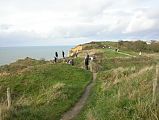
Surroundings and natural setting
Cap de la Hève is a watch point for active migration, situated in the south of Pays de Caux at the mouth of the Seine estuary, a strategic site for migration with important concentrations of birds. Owned by the Conservatoire du Littoral, the sited has been designated a ZNIEFF of type I and II in the NDL zone of the local urbanisation plan. Habitats include aerohaline grasslands, thickets, bushes and calcicolous woodland. It is bordered by a coastal footpath, close to northern suburbs of Le Havre with its 300.000 inhabitants.
Ornithological interest, emblematic species
This migration watch point has been discovered and has been visited irregularly since 2000. It could still be reserving surprises, both in the number of birds and the species encountered. We estimate that between 300.000 and 450.000 migrants are passing each autumn. Over 130 species have been recorded since 2000. The composition of the migratory flow is quite similar to other coastal sites in northwestern France. The two most numerous species are Starling and Chaffinch. Next are some species totalling several thousands in autumn: Meadow Pipit, Song Thrush, Redwing, Siskin... or several hundreds of individuals such as Linnet, Greenfinch, Tree Pipit... Other less common species which are still regularly seen at Cap de la Hève include Tawny Pipit and Ortolan Bunting (both species in strong decline), Hawfinch, Crossbill or Lapland Bunting. Among the birds of prey, Sparrowhawk is regularly seen. Several rarities have been found, such as Richard's Pipit or Siberian Stonechat, both originating from Siberia! If you want to see some good bird migration (and see several tens of thousands of birds in a single morning), the ideal period is between mid October and mid November but it is worth visiting the site between mid August and mid November to see the succession of species (pipits, wagtails and swallows, followed by finches, pigeons, thrushes, geese...).
Visitors
There is no permanency at the site but there are a few regular observers. If you are interested in a guided visit or events at the site, see contact.
Access
From the railway station, follow Porte Océane, alongside the beach, and head for the cliffs in front of you towards Cap de la Hève on the heights of Sainte-Adresse. There is a car park near the lighthouse of la Hève. The closest railway station is Le Havre (6 km from the site); there is a direct line at 2 hours from Paris (Saint-Lazare railway station).
By bus from the railway station: take line n° 1 (La Hève).
From the car park, follow the gravel track on the edge of the cliffs. The best site for watching is situated about 200 metres north, near a bunker, and offers a wide view over the mouth of the bay (sea birds) and the gulley of Ignauval.
Places to stay and eat
Information on places to stay / to eat: office de tourisme: http://www.lehavretourisme.com
Contact
Blog of Cap de la Hève (since mid September 2007)
http://oiseauxmigrateursdelaheve.blogspot.com
GROUPE ORNITHOLOGIQUE NORMAND (GONm)
181, rue d’auge
14 000 Caen
LIGUE POUR LA PROTECTION DES OISEAUX (LPO) Haute-Normandie
2, rue Geuffroy
im. Panorama 2
76 100 Rouen

 Sightings
 Stats