The site
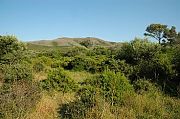
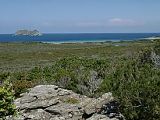
The village of Barcaggio (municipality of Ersa) is located at the head of Cap Corse, where the river mouth of the Acqua Tignese reaches the bay. This part of Cap Corse has been designated a protected area under the 1930 Law, whereas a nature reserve includes the isles of Finocchiarola. Many sections of the coastline are owned by the Conservatoire du Littoral. Willows are growing in the widening valley, a most attractive habitat for birds, taken over by maquis with areas of brambles and meadows. Behind the dunes, two lagoons are attracting waterbirds and other forms of wildlife. The head of Cap Corse, with the Acqua Tignese valley, is a bottleneck for migrants. A mosaic of habitats attracts a good variety of bird species. This is a truly exceptional stop-over site, with no disturbance and plentiful of food and shelter. Migrants, that have covered hundreds or even thousands of kilometres, need refueling. They will build up fat reserves before leaving or may need a short break to recover and preen the plumage. Birds will often rest before crossing a vast expanse of water. They will await fine weather conditions and improve their physiological condition, because out at sea, there are few places to land for birds without a watertight plumage or webbed feet! 236 bird species have been recorded at the head of Cap Corse (including breeding birds, migrants and sedentary species) such as swallows and martins, swifts, flycatchers, warblers, yellow wagtails (different taxa), Red-throated Pipits, mediterranean Sylvia warblers, and on migration Hoopoe, Wood Sandpiper, Temminck's Stint, crakes, Night Heron, Squacco Heron, Little Bittern, Honey Buzzard...
Where do the migrants at Barcaggio come from and where are they going to?
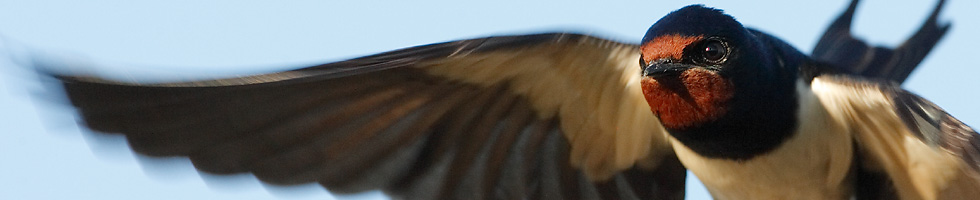
Among the species at Barcaggio, birds from all over Europe can be found, from Lithuania to the United Kingdom and from Finland to Slovenia. The migrating Robins are wintering in Algeria and breeding in eastern and northeastern Europe. Willow Warblers come from northern and eastern Europe. Barn Swallows from the whole of Europe are heading for winter quarters down to South Africa. There are also some ringing recoveries from local birds, giving an idea of there life span and the evolution of their plumage.
History
The migration study camp at Barcaggio started in 1979. CRBPO ringers (French Ringing Service) of the Paris Natural History Museum and volunteers of the Groupe Ornithologique de Corse (Association des Amis du Parc Naturel Régional de Corse), participate in camp organization and the functioning of the camp. This was also possible thanks to the presence, each year, of ringers and trainees coming also from the European mainland.
Since 1991 the camp is cooperating with the international research programme of spring migration on islands in the western Mediterranean, Piccole Isole. This programme, initiated in 1988 by the Instituto Nazionale per la Fauna Selvatica (INFS) of Bologna (Italy) is being organized at several insular and coastal sites (38 different sites in all since 1988). These sites are situated in Italy, Spain, Malta, Morocco, Tunisia, Algeria and France. It is noteworthy that Barcaggio has been for a very long time the only French site participating in this programme. Since 2006, the camp is equally included in the monitoring of stop-over sites by CRBPO. Since 1999, ringers and assistant ringers are being lodged in the Maison des Oiseaux (the Bird House), a former ruin, restaured by AAPNRC. This place to stay is quite practical for refueling the team that is in the field between 5h30 and 22h00 and for sleeping a few well-deserved hours!
AAPNRC is financing the camp, more particularly by supplying salaried staff. The financing is partially integrated within multi-annual conventions between the association, the Office de l'Environnement de la Corse and the Corsican DIREN. In previous years, the camp has also benefitted from PIC INTERREG II A Corsica-Tuscany as well as funding by Foundation Nature et Découvertes. The refurbishing of the house have also been sponsored by Conseil Général de Haute Corse, collectivité Territoriale de Corse, Ministère de l'Ecologie et du Developpement Durable and Europe (INTERREG). The functioning of the camp is guaranteed by the annual presence of 30 volunteers, ringers, assistant ringers and trainees, coming from Corsica, France and various European countries (Italy, U.K., Switzerland, Spain, Norway, Iceland, Hungary).
Ringing results since 1979
The camp has had its ups and downs between 1979 and 1990. In 1985, no camp was organized. Since 1991, and with the cooperation of the programme Piccole Isole, the camp has been run daily between 16 April and 15 May. The regularity in the functioning of the camp since 1991 is providing cumulative data comparable between the years. Between 1979 and 2007, 56724 birds of 129 different species have been ringed during 687 days of ringing.
Practical information
Calendar of the ringing camp: between 16 April and 15 May, from dawn till dusk.
Information to visitors is provided during the days and opening hours of the ringing camp.
Access (by car and public transport): by car take the D80 from Bastia to Ersa and then the D253 to the hamlet Barcaggio. You can leave your car at the car park at the start of the sentier des douaniers (base camp is close to a footbridge over a small stream).
Places to stay and to eat:
- Camping site and bungalow rental U Stazzu
Route de la plage,Macinaggio (Open from 01/04 till 30/09) ; Tel 04-95-35-43-76
- Les gites du bout du Cap, ERSA Tel 04 95 31 64 33 ; 06 82 30 27 15 Fax 04 95 32 46 31 http://location-cap-corse-giraglia.com
Contact
Gilles Faggio
Association des amis du Parc naturel régional de Corse / Conservatoire des espaces naturels de Corse
Maison Romieu, 15 Rue du Pontetto, 20200 Bastia ; phone 04 95 32 71 63, fax 04 95 32 71 73
Email : mailto:aapnrc@wanadoo.fr & Web site : http://www.amis-du-parc-naturel-corse.org

 Sightings
 Stats
Stats