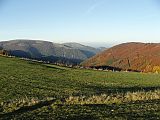
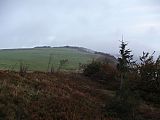
Natural surroundings of the watchpoint
The mountain pass is located in the Central Vosges, in the Munster valley between Batteriekopf (1311 m) in the north and Schweisel (1271 m) in the south. It is one of many cols scattered along the summit line. The pass, roughly oriented north-south, separates the Fecht valley in the east (Munster) and the Thur valley in the west (Kruth). Mountain pastures are the summer grazing grounds for cattle, including the black and white Vosges, a breed native of the Vosges Mountains. Below 1000 m, mountain Beech forest grows near the timberline, with climatically distorted and stunted trees, replaced lower down by tall mixed mountain Beech and Spruce forest.
History of the survey and environmental issues
Unfortunately, the site has never been properly surveyed. At the end of the 1960s, local birders noticed its ornithological importance but their data never reached the archives of the local LPO branch. The first partial counts date back to 1976, with a simultaneous count at all major cols in the Vosges Mountains. Subsequently, only the counts from the early 1990s have been sent to LPO Alsace. They can be found on migraction.net.
Hunting migratory birds is not a deeply rooted tradition among hunters in the Alsace region. Since the middle of the 20th century, however, some local hunters started hunting Woodpigeons on certain cols. The habit still persists at col du Herrenberg which is more accessible by car now than it used to be in the old days. The impact of hunting is rather limited but the presence of hunters nearby the watchpoint is disturbing and potentially dangerous.
Ornithological interest, emblematic species
The watchpoint is mainly interesting during autumn migration. During spring, the migratory flow is far less important according to scant local sources.
Near Colmar, some migrants from the Rhine valley are funneled into the Munster valley. Beyond Munster there is a choice among four valleys towards the Higher Vosges. The two main flows head towards Herrenberg and Hahnenbrunnen. Once across the col, the birds take the Kruth valley or cross the Ventron crest towards the west.
Most of the migratory species that cross the Vosges Mountains can be seen at Herrenberg. Like elsewhere, Woodpigeon, thrushes, tits (particularly during influx years) and finches are the commonest species. Certain years, Woodpigeon can be seen in big numbers: e.g. a daily maximum of 120 000 in October 1975 (Jean-Jacques Pfeffer, in litt.).
Migration calendar
The main migratory flow usually occurs between 1st and 20th October. The migration pattern, however, is not known in detail, through a lack of regular surveys. It is expected not to differ very much from that of other Vosgean cols (e.g. col du Markstein).
Visitors
There is no visitor accommodation at the site.
Access
By car, follow the « route des crêtes » (D430), a former military road that follows a ridge line route. Once at the Huss farmhouse B&B, take the dirt track towards the eastern slope, park your car as soon as possible and take a short walk (100 m) to join the mountain pass beneath. The “route des crêtes” can be reached from Munster (via col de la Schlucht – D417 or Sondernach – D27), from Kruth (via Markstein – D27) or Thann (via Grand Ballon and Markstein).
Where to stay and where to eat ?
The farmhouse B&B « Huss » upslope from the col on the west flank, offers local “marcaire” dishes (between the end of May and mid October). “Marcaires” are local farmers, breeders and cheese makers. At 300 m, the similarly named chalet from the Mulhouse ski-club has a few rooms (during weekends only). Other options include to drive to col de la Schlucht (10 km to the north), Markstein (10 km to the south) or to drive down to Metzeral in the Munster valley.
Contact
Original text written by

 Sightings
 Stats
Stats