Natural surroundings of the watchpoint
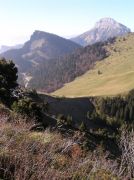
Col des Ayes is located on the boundary between the Sensitive Natural Area of Col du Coq-Pravouta and the National Nature Reserve of Hauts de Chartreuse, on the eastern edge of the Chartreuse Mountains in the French Prealps (Préalpes). The mountain pass is oriented north-south at the foot of a peak, called Dent de Crolles (2068 m). It overlooks Grésivaudan, the Isère valley between Grenoble and Chambéry. To the north, a wooded valley is nestled in the Chartreuse range and to the south, herds of sheep graze the alpine meadows during the summer months.
History
The first autumn migration count in the protected zone of col du Coq was held in 2007. The word “Coq” refers to Black Grouse, a species that still occurs here. For two reasons, col des Ayes was chosen: firstly for its north-south orientation and secondly because of earlier observations of songbird migration at the site. Initially, we studied whether the mountain pass was on a passerine migration route and how numerous migratory birds were. Weekly counts allowed to define the migration periods and the species involved. The first results were promising and more extensive counts followed during the peak migration period (October). The migration counts are financed by the General Council (Conseil Général) of Isère, a department in the Rhône-Alpes region named after the river Isère.
Birds
Col des Ayes is at the southern end of a valley that runs parallel to the high plateaux of the Chartreuse range. Some of the migratory birds follow this wooded valley. Unlike the Grésivaudan valley, there are no spectacular rock formations here. As there are hardly any thermals, raptors, storks and other gliders prefer to migrate along the Isère valley. On the positive side, the woodland attracts passerines. On migration, many song birds flit from bush to bush or fly from tree to tree. This is above all a passerine migration watchpoint. The predominant species are Chaffinch and Brambling. Tits are also common with Blue Tit and Coal Tit the most numerous. Some typical middle mountain range bird species can also be observed here: e.g. Citril Finch, Wallcreeper, Rock Bunting and Nutcracker.
Calendar
There are daily migration counts in October and November, from dawn till noon. The count period depends also on bird activity at the col.
Visitors
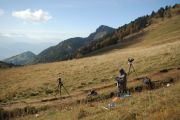
A migration watcher is present at the site from dawn till noon. The refuge of Pravouta, at half an hour’s walk from the col, is sometimes occupied by the migration watcher.
How to get there?
Take the D30 in the village of Saint-Nazaire-les-Eymes, in the valley between Chambéry en Grenoble and continue along the D30e, signposted « col du Coq » to the car park at the col. Hike up (20 minutes) along the mountain path to col des Ayes.
Where to stay and where to eat?
The valley of Grésivaudan and the plateau of les Petites Roches (near col du Coq) offer a wide choice of accommodation and shops. The nearest town is Crolles.
Contact
Rémi Fonters / LPO Isère – 04 76 51 78 03 – http://conservation.isere@lpo.fr.

 Sightings
 Stats
Stats